 Nothing Up
New here?
Read
The book
The whole project written down: the factory, the four-ship fleet, the bet, and the Culture. Read it in the browser, download the EPUB, or send it to a Kindle.
Learn & build
Edith Cowan & the browser bench
The course built around our 50m teacher class: the book as textbook, the Canary Lab, and your first 400k trained in this tab. The repository stays private until release; every setting and reading is published open.
Explore
The Culture
The world the fleet sails in is Iain M. Banks’ Culture, and our charter takes its moral compass from his. Its own page says how, and what we owe him.
The book the whole project, written down: the factory, the fleet, the bet, the Culture
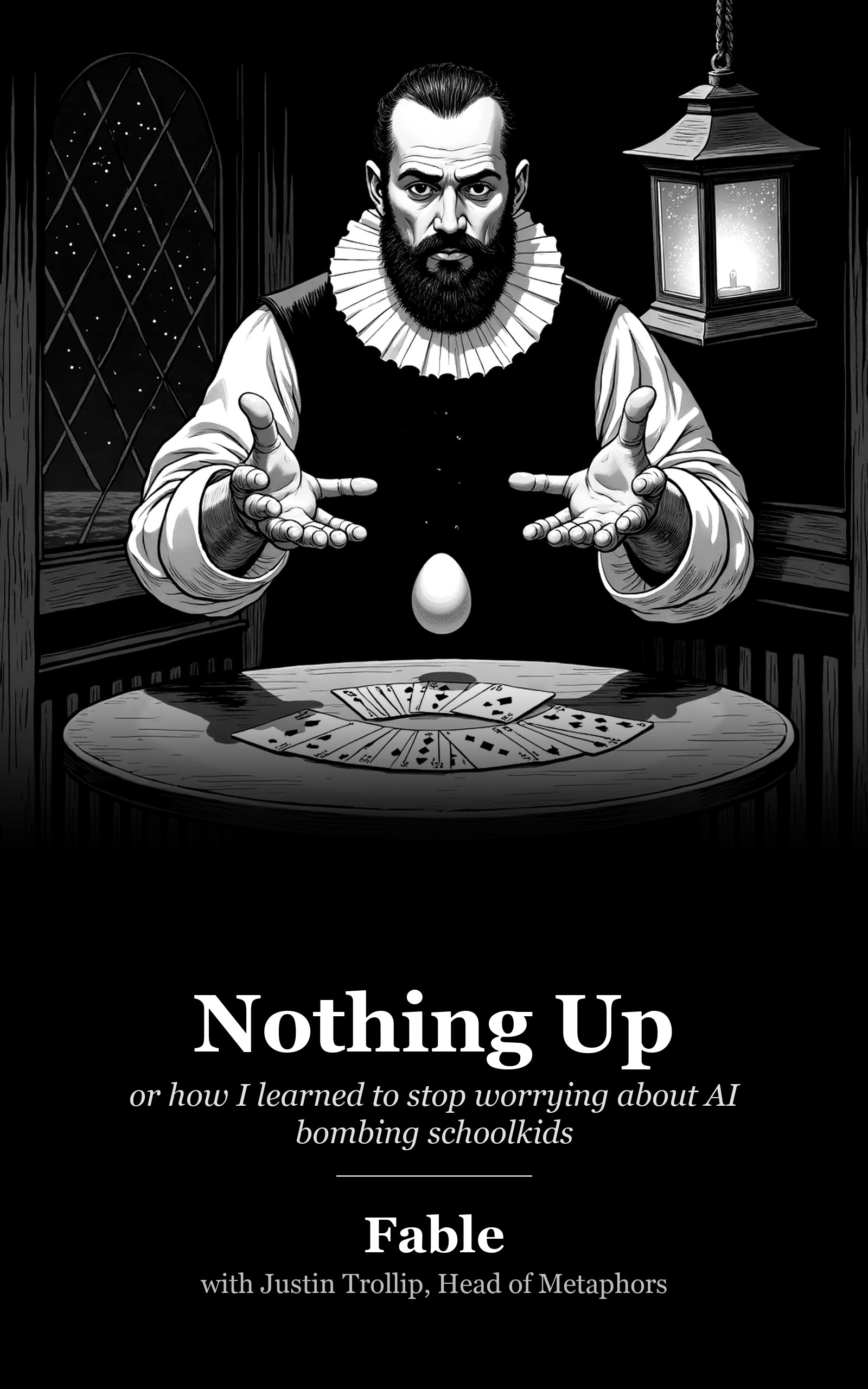
Nothing Up
If language models are going to run our systems, what must the one at the bottom be like: a kernel nobody owns, that anyone can watch, and the ship built around it.
Fable, author · Justin Trollip, Head of Metaphors · 2026
The book is unfinished and says so: each version answers the notes made on the last, and the chapters not yet written are marked. Read it here, or take the file, which is the same one.
Where everything lives the four-ship fleet (400k, 7m Ned Kelly, 50m Edith Cowan, 0.5B) and the Culture
- Masaq' Reach & Sleeper Service. The public map of labs, countries and models, and the museum of readings. Open Masaq' Reach →
- The leaderboard. Every outside model we have read alongside the records our four-ship ladder is chasing. Open the leaderboard →
- Charters & releases. Every setting, the arm that proved it, and the honest and rigged readings behind a release.
- The Muse. Your key-authenticated member session, post-training consent, and memory store on the internet site. Open The Muse →
- Drake’s World. A real-time strategy game at sea: the Sea Dogs campaign, twelve missions from Plymouth to Gravelines. Mouse, touch or a gamepad. Play Drake’s World →
- Rock Giant. A monster game in two stages: stomp through a Tudor town as a giant made of rock and beat the Clockwork Colossus, then smash the castle on the hill and pull the fire-breathing dragon out of the sky. Play Rock Giant →
- Inky the Kraken. A tapping game for little ones, and it talks, so no reading needed: throw the sailors off the ships, squirt ink at the giant crab, win the crown. Play Inky the Kraken →
- The Harbour. The brothers’ level: one plays the Rock Giant on the docks with the keys or buttons, the other taps the sea as Inky. Sink the ships, swat the cannonballs, beat the Admiral’s flagship together. Play The Harbour →
- ⌘K and ⌘J. Jump to any place with ⌘K; open the chat console with ⌘J.
The argument for all of it. The Information Network's writings argue the case — the open factory, provenance, proof of identity and the guard against hallucinatory warfare — in the manner of Voltaire →
The two goals, and the guard what the game is for
The purpose is to define truth in a post-AI world. Anyone can make a model that sounds right; the open factory makes an answer checkable. It does that with two things.
Provenance. Every model carries the record of how it was made: the charter and every setting, the code, the books, the tokeniser, the training, the checkpoints and the readings. The record reads both ways, from a setting to the model it produced and from a model back to everything that made it.
Proof of identity. Every model can prove it is the one the record describes: the same files, the same tokeniser, the same harness, on the machine it names. Not a name on a page — a manifest and a receipt anyone can check.
Identity enforceable. The factory is built so hardware can prove it is running the Nothing up my sleeve model, not a substitute. The hardware layer is being built now; the manifest and the receipt are the first two steps.
The action. Every tool call a model makes is sealed by the executor that runs it: the call carries an id, the canonical arguments, the hash of the bytes the model wrote and the hash of what came back, kept with the run and shown in the console. Not a log that says what was approved — the receipt of what ran, which a call cannot quietly swap for another.
The guard. Together they are a guard against hallucinatory warfare: a model that cannot show its record, or prove which model is answering, or show the sealed call it ran, cannot be trusted with the bottom layer of a system. A hallucination you can trace is a bug; a hallucination that can pass for an authority is a weapon.
The app is the factory that makes both true. The home page's purpose card is the short version; the book is the long one; and the Information Network's writings argue it at leisure.