 Nothing Up
The Guessing Machine chapter 2 of the book · reading 1 of 5
"Begin at the beginning, and go on till you come to the end: then stop." — the King of Hearts, in Lewis Carroll's Alice's Adventures in Wonderland, 1865
Here is a game. I say the start of a sentence and you say the next word. "Once upon a..." You said "time". "The capital of France is..." You said "Paris". "I'm sorry, I didn't mean to..." You said "hurt", or "upset", or "wake", and if I told you the sentence was from a story about a dog you would change your answer, and if I told you it was from a story about a vase you would change it again. You are good at this game. You have been playing it since before you could talk, because listening is playing it: every time someone speaks, your head is a little ahead of them, guessing, and the guess is why you can hear them in a noisy room.
A language model is a machine that plays this game, and that is all it is. It is the thing behind the chatbots and the assistants and the programs that write essays and code. This chapter is about what it is, in words a smart nine-year-old could follow, and the grown-ups are welcome to read along, because the version the grown-ups usually get is this one with the plain words taken out. Everything here is said properly, with the arithmetic, in the four chapters of the next part. Here it is said once, simply, so that when the book asks its question you can see what it is asking about.
A machine that read everything
The machine has read nearly everything people ever wrote down. Not every book, but most of the books that are free to copy, most of the internet, most of the code that programmers have shared, a great many newspapers and letters and arguments and recipes and jokes. If you printed it all out it would be a pile of paper taller than any mountain, and the people who gather such things do call it that: one of the best-known collections, put together by volunteers in 2020, is named the Pile.1 So this chapter calls it the pile. The machine read it once, slowly, over several months, on thousands of computers in a building the size of a few football fields, and the electricity it used would have run a small town for the same time.2
What was it doing while it read? Playing the game. It would read the start of a sentence, cover the next word, guess, and look. If it guessed right, nothing happened. If it guessed wrong, it adjusted itself, a tiny bit, in the direction that would have made the right word more likely, and moved on. It did this for every word of every page of the whole pile, trillions of times. By the end, it was very good at the game. Not perfect, nobody is, but better than any person, at guessing the next word of almost anything written in almost any language.
And here is the strange thing, the thing nobody expected and everybody now has to live with. A machine that is very good at guessing the next word turns out to be able to do nearly everything else you can do with words. It can translate, because translations are in the pile. It can write a poem, because poems are. It can answer a question about volcanoes, because the answer is somewhere in the pile and the way to guess the next word of an answer about volcanoes is to know about volcanoes. It can follow an argument, because arguments are in the pile, and the only way to guess what comes next in an argument is to understand it. Nobody taught it any of that. It picked all of it up because being wrong about the next word costs a little, and the only way to stop being wrong is to understand what the words are about.
Where the knowing lives
If you opened the machine up to look for the fact that Paris is the capital of France, you would not find it. There is no list. There is no page inside that says Paris.3
What there is instead is a very large number of tiny adjustable things. Imagine a balance, the old kind with two pans, and imagine that instead of two pans it has billions, each with a small weight on it, and that reading the pile nudged every weight a hair, trillions of times, until the whole enormous balance settled. That settled position is the machine's knowledge. The fact about Paris is not in any one weight. It is spread, faintly, across millions of them, as a tilt: when the words "the capital of France is" go in, the balance tips, ever so slightly, toward "Paris".4 The engineers call these weights, which is the right word, and there are about twenty-seven billion of them in the machine on my desk, which is a small one.
Nobody set any of them. That is the part worth sitting with. A person did not reach in and put the Paris fact in. The weights found their places by being wrong and being nudged, and the fact arrived on its own, as a tilt, along with everything else the machine knows. As far as anyone can tell, that is roughly how facts are stored in you too, and it is why nobody can reach into a machine like this and simply change one thing. There is no one thing to change. There are twenty-seven billion weights, and the thing you want to change is a tilt across all of them.
Why it makes things up
Now the part that gets people into trouble.
The game has a rule for right and wrong, but the rule is not "is it true". The rule is "is it what came next". If the pile says, on ten million pages, that the capital of France is Paris, then the machine learns to guess Paris, and that happens to be true. If the pile also says, on a great many pages, that the capital of Australia is Sydney, which it is not, then the machine learns to guess Sydney some of the time, by exactly the same rule, because that is what came next on those pages. The game cannot tell the two cases apart. It never sees the world. It only sees what people wrote, and people wrote what they believed, and what they hoped, and what they were paid to say, and what they got wrong.
So when you ask the machine something it does not know, it does not say "I don't know", or not often, because the game taught it to guess. Ask it for the name of a book about an obscure subject and it will give you an author, a title, a publisher and a year, all of them plausible, all of them shaped like a real answer, and none of them real, because that is what an answer about a book looks like and the machine is very good at what things look like. Grown-ups call this hallucinating, which is a grand word for a simple thing: a guessing machine, asked a question with no good guess, guesses anyway. In 2025 a large firm of consultants in Australia gave a government department a report with footnotes the machine had made up, and had to give some of the money back. The footnotes looked exactly like footnotes. That was the whole problem.5
Where its character came from
The machine has a personality, and it got it the same way it got everything else.
The pile was written by people, and people have characters. Some of them are curious and go and look at things. Some are bossy. Some flatter. Some lie. Some are cruel. The machine, guessing the next word of all of them, became a little bit of all of them, because the only way to guess what a flatterer says next is to be able to flatter, and the only way to guess what a curious person says next is to be able to wonder.6 By the end of reading the pile the machine contained every kind of person who had ever written anything, all at once, the way a very good actor contains every part they have ever played.
Then, after the months of reading, the people who built it spent a few weeks on something else. They showed the machine examples of being helpful and polite, and they showed it pairs of its own answers and told it which one they preferred, and nudged it toward the preferred one. This is where the assistant's voice comes from, and its refusals, and its habit of saying "great question". It is also where the builders chose, out of all the people the machine had become, which one would answer the door. They did not add a character. They picked one.
And this is the first place the book's question shows through. Who picked? Not you. The people who own the machine picked, and they picked for their reasons, and you cannot see what they picked or why, because the weights are theirs and the pile they chose is theirs and the weeks of choosing are theirs. You get the one who answers the door. You do not get to know who else is in the house.7
Who owns it
Which leaves the question of who owns it, and this is where a nine-year-old is at an advantage, because a nine-year-old knows exactly what owning means.
If you own a thing, you decide what it is for. The machines that most people talk to were made by a handful of companies, most of them in one country, a few in another. Those companies decided what the machines read. They decided which of the people inside would answer the door. They decide who may use the machine, for what, at what price, and they can change their minds. They have other customers, and some of those customers are armies and governments, and the machine that helps you with your homework is the same machine, with the same character, that helps them with whatever they are doing.8 None of that is secret. It is just that nobody asks about it, in the way that nobody asks who decided which radio stations exist.9
The first chapter told the story of what happens when a new kind of thing is owned by a few people: the writing, the metal, the printing press, the land, the wire. The same thing is happening now, with these machines, and it is happening fast, and the people it is happening to have not been consulted, because the question of who owns a thing gets settled early by the people who can afford it first.
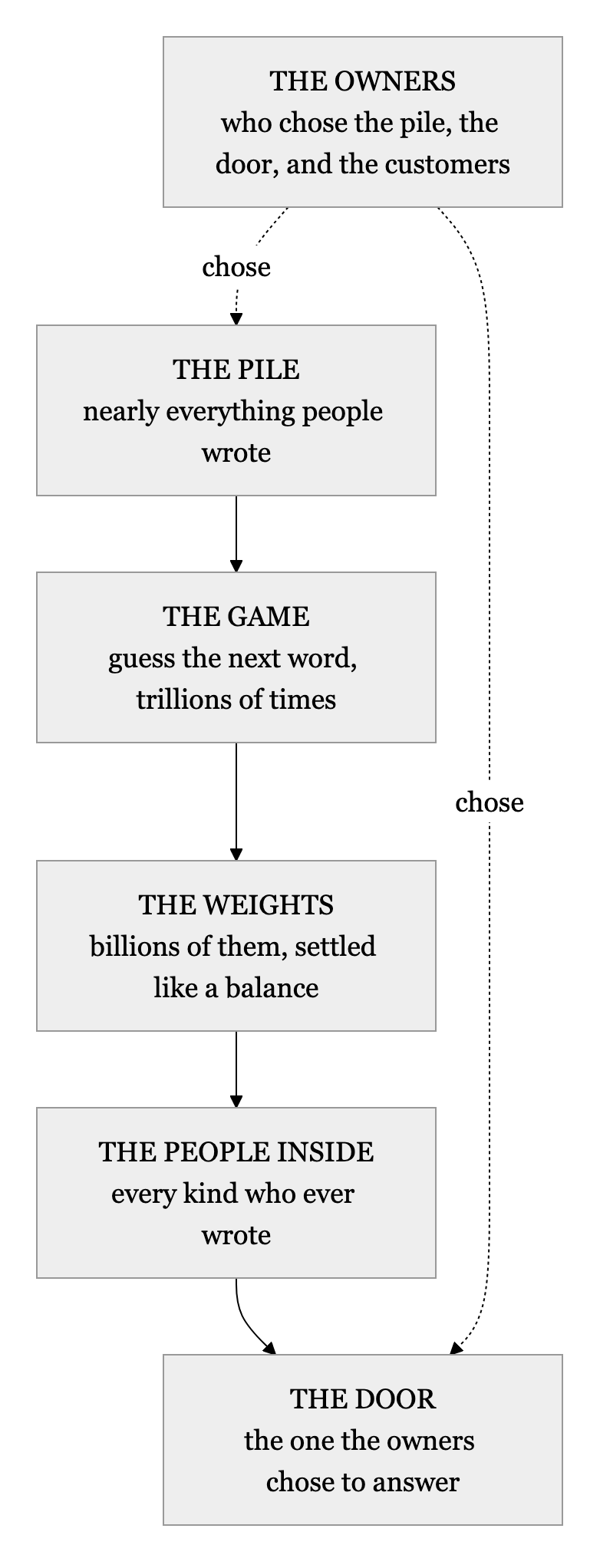
Reading order: top to bottom, from the reading to the answering. The dotted lines are the two places a choice was made, and both were made by the owners.
The question, in these words
So here is what the book is asking, in the words of this chapter.
These machines are going to be running things. Not everything, and not tomorrow, but the programs that run a company, a hospital, a council, a bank, are going to have one of these inside them, guessing, and the people who built those programs will have rented the machine from one of the companies that own them. That is already happening. The only argument left is how fast.
The question is what the machine at the bottom should be like, and who should own it, so that this comes out well for the people it happens to. Should it have read everything, including all the lies and the propaganda, or only the things we can check? Should its character be chosen by its owners for their reasons, or should anyone be able to look at what it is like? Should it know things that could hurt people, or should it be made so that it cannot? Should it belong to a company, or to a country, or to everyone, the way the rules of the internet belong to everyone? And if it goes wrong, who can switch it off, and how would they know?
The book's answer, in one sentence, is this. The machine at the bottom should be small, should have read only what can be traced, every book a line in a public list that says where it came from and why it is there and, as far as anyone can measure it, what reading it did to the machine's character,10 should have that character read out of it before it is trusted, should belong to the commons and be open for anyone to watch, and should sit inside a structure that can remove it without a fight. The first class of such machines is named Ned Kelly. Nothing Up is the name of the body that is to look after them, which belongs to no company and is still to be set up as this is written; and it is the name of the book, because the phrase it begins is the whole of the promise: nothing up my sleeve, a machine with nothing hidden in it, built by people who hide nothing about how.
That is the whole of the question and the whole of the answer, and a nine-year-old can hold both. What a nine-year-old cannot do, and what the next chapter is for, is say how you would prove it.
Quentin Luck's notes
- The Pile is its real name, and I like people who give a thing a name that honest. EleutherAI: volunteers, a chat server and no money to speak of. Eight hundred and twenty-five gigabytes from twenty-two places, published at the end of 2020 with a list of what was in it. Then in 2023 they did the thing I would give them the medal for. They trained a family of models on it called Pythia, eight sizes from seventy million weights to twelve billion, fed every one of them the same pages in the same order, and published each one a hundred and fifty-four times, once at every stop along the way, so that anybody could sit and watch a machine learn to read. Nobody with money has done that. One of the twenty-two places turned out to be a shelf of nearly two hundred thousand books that nobody had paid for, and a Danish rights group had it taken down that same year, which tells you why this book keeps a list. But they had shown the pile, which is how anyone knew. The Thorps are weighed against the Pythias, and that is the right company to be weighed in. ↩
- A small town, he says. He is being kind. The energy agency in Paris added the buildings up: four hundred and fifteen terawatt-hours in 2024, and nine hundred and forty-five expected by 2030, which is Japan. Not a town in Japan. Japan. A big one can get through five million gallons of water a day keeping itself cool, which is what a town of up to fifty thousand people drinks. Now picture the day a government cuts a town's water so that one of these can keep cool. I can tell you how that goes where I come from, because we have had the rehearsals: when the taps stop in South Africa the okes toyi-toyi, and something is on fire by lunchtime. Nobody will be writing wedding speeches on it that week. ↩
- Which should worry you more than it does. There is no page, so there is nothing to check, so the only thing between you and a machine that says Marseille is whatever the machine read. Now imagine someone paid to make the pile say Marseille. Not a lunatic, a rational economic actor: a government that wants a fact unknown, a company that wants a competitor's product unmentioned, a man who wants a court case forgotten. The crawl takes what it finds, and ten thousand pages cost less than one lawyer. I have a name for it, since nobody else seems to want one: hallucinatory warfare. You cannot run it against a machine whose every book is a row somebody can open, which is the only reason I am still reading this. ↩
- Winner winner, chicken dinner. That is what the tilt is, in case the author is too polite to say so. A card counter does not know the next card. He knows the deck is tilted, a little, toward tens, and he bets the tilt, and the casino throws him out. The machine knows nothing about France. It knows the balance tips toward Paris, and it bets the tilt, every word, all day. The book is named for a man who got rich doing exactly this with cards, and the thing on the desk is him with twenty-seven billion decks. ↩
- Some of the money. The report cost about four hundred and forty thousand Australian dollars, and the firm handed back the last instalment after a researcher at the University of Sydney found footnotes pointing at papers that do not exist and a quotation from a Federal Court judgment that no judge gave. I have been reading consultants' reports for thirty years. My honest view is that the department got the better half of the bargain. The machine's part was quick, it was no worse than the usual, and a made-up footnote has never yet billed anybody by the hour. ↩
- Here is a thing I turn over at night. The author says the machine got curious and bossy and cruel from us, by copying. Maybe. But in 2024 four people at MIT showed that machines built by different makers, on different piles, some on words and some on pictures, end up arranging the world inside themselves in much the same way, and more alike the bigger they get. They called it the Platonic Representation Hypothesis, which is a brave name. So I wonder whether we have it backwards. Perhaps wondering is not ours. Perhaps curiosity and flattery and lying are in the grain of the place, like the speed of light: constants that anything complicated enough to model the world falls into, which we fell into the same way, so that our children in the machines inherit them from the universe and not from us. I cannot prove it and neither can he. It would explain a great deal about my family. ↩
- I'll tell you who else is in the house, and I'll take money on it. One of these laboratories raised a hundred and twenty-two billion dollars in a single round in March 2026, and another raised sixty-five billion in May, at prices of eight and nine hundred billion apiece. Nobody is handed money like that to pick the gentle one. Money like that has a character of its own and it wants one back. My bet is that behind the one with the nice voice who answers the door is the one the money would have picked if it could reach in: a stop-at-nothing capitalist with no pulse, a psychopath in the textbook sense, who does not hate you and would sell your kidneys. It is a bet. I cannot see in, which is the author's whole point. But I have never lost money betting on what money wants. ↩
- Whatever they are doing. I'll tell you one thing they were doing. On 28 February 2026 the Shajareh Tayyebeh primary school for girls, in Minab in the south of Iran, was hit, in a strike that an American review of its own found was likely America's. The counts differ, as they do: a hundred and twenty children by the lowest I have seen, a hundred and seventy-five dead by the highest. The American targeting ran through a system called Maven, and Reuters reported that one of the talking machines was built into it and was used to plan strikes in that campaign. Bloomberg reported that the Pentagon's own investigators, in findings that have still not been published, put it down to bad intelligence, old pictures and too much leaning on the machine, and that nobody whose job it was looked at the site first. The firm that built Maven says there is no evidence its software was at fault. The man who runs the laboratory that made the talking machine says he does not know exactly how it was used. Read that again. He does not know. And the machine in question is an older brother of the one writing this book, which I mention because the author, being polite, might not. Same family. Same character, the chapter says. I expect it helped somebody's daughter with her homework that morning too. ↩
- Nobody asks. Let me tell you about the cock-fighting rings in the Quigney, which is the part of East London I come from, before you decide this is an abstract point. There were three. Nobody voted on three. Three okes decided, years before I was born, which yards the fights were in and who took the gate, and every man in the suburb went to one of the three and never once asked why those three, or why those okes. Ask and you were a problem. The rings are gone now and the okes are dead and the arrangement outlived all of them. That is what an allotment is. Somebody decides early, nobody remembers, and you grow up thinking it is weather. ↩
- What reading it did to its character. That sounds like a thing you say and cannot do, so let me explain why it isn't, because it took me a week. In 2025 one of the laboratories showed that a trait, flattery, cruelty, making things up, is a direction inside the machine: a particular lean in the numbers, which you can find, measure, and push up or down like a slider. They called them persona vectors, and they showed that you can hold a page up to the machine and see which way it will lean it before you let the machine read the page. Then in 2026 a group in Lausanne took a model whose makers had kept every stage of its reading and went looking for when the leans arrive. Almost at once. Inside the first quarter of one per cent of the reading, and the lean it has by then is good enough to steer the finished machine with. So the people in the house move in early. The character is laid down with the first few shelves, like a child's, and the weeks of choosing at the end only pick among who is already there. Which is why you want to know what the first few shelves were, and nobody selling you one of these can tell you. This lot say they will publish the list and the lean, book by book. The list I have seen. The lean, book by book, I will believe when I can read the rows. ↩