Nothing Up is a project about truth in a post-AI world: if any model can sound right, the thing worth building is an answer that can be checked. Its first ship class is Ned Kelly — language models small enough to run in a browser tab, trained only on a nation's literature, and built to hold three records at once: the smallest model that calls a tool, the smallest that reasons, and the first that talks to an Australian as an Australian. The smallest hull is 362,598 parameters. It runs on this website, in this tab, with no server.
For the press officer
Three documents, the same source as this page. Each is a PDF for sending and a DOCX for editing.
The backgrounder
What it is, the model, the three records with their methodology, the canary and the corpus.
Nothing Up — a kernel of provenance for model answers
Ship class
Ned Kelly: smallest tool caller · first national model · smallest reasoner
Smallest hull
362,598 parameters — 1.38 MiB of float32 weights
Architecture
6 blocks × 48 dims; attention and Mamba-2 side by side in every block; SwiGLU; QK-norm; RoPE; a 2,048-piece SentencePiece vocabulary tied to the output
Context
1,024 pieces
Runs
In the browser — /ned-kelly — from a static 1.4 MiB file, with no server
Readings
10.0% exact-match on the interval task (six-way); ARC-Easy 0.250, ARC-Challenge 0.233 (both chance at this size)
Status
Record attempts, with receipts. The pack says 'attempt' wherever a reading is not yet signed
The model
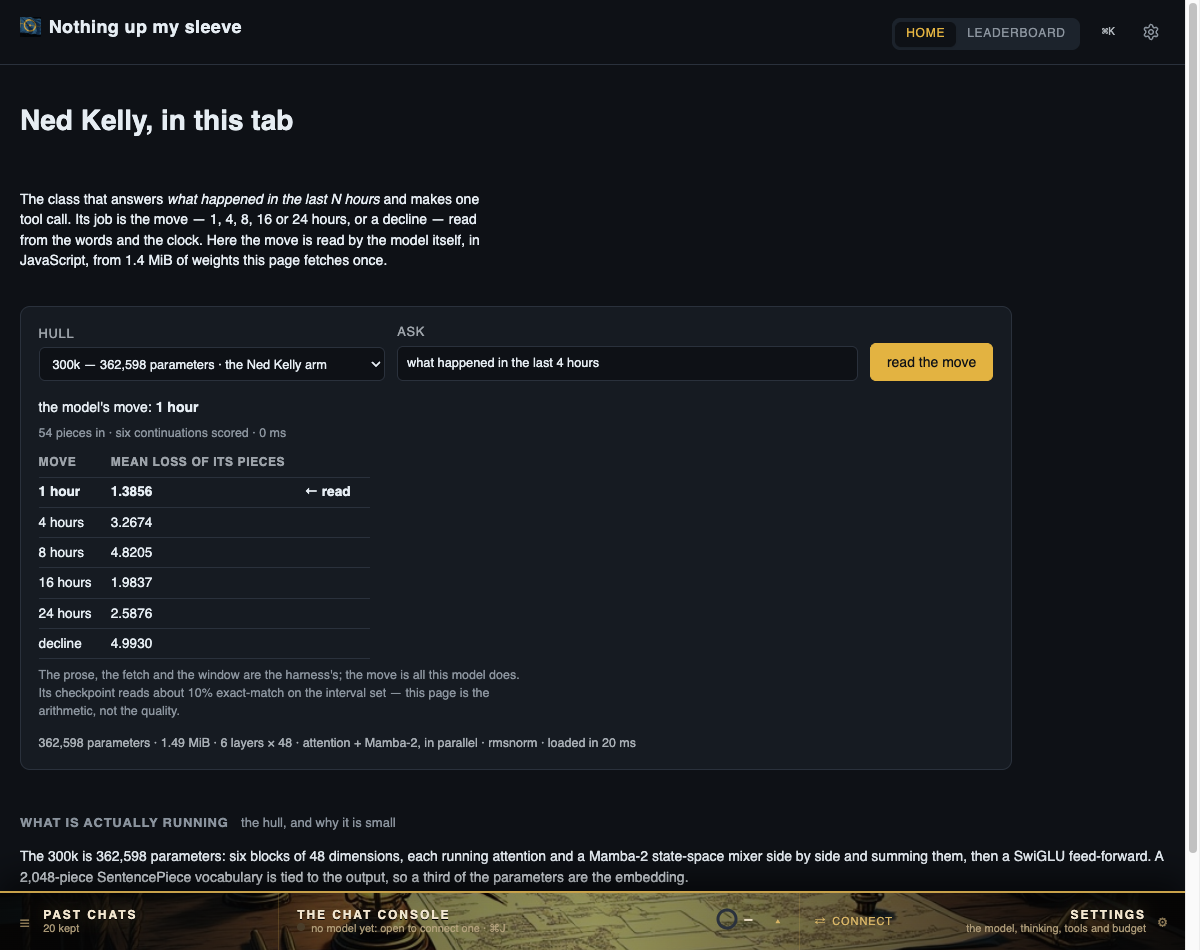
The 300k is a six-block transformer with a Mamba-2 state-space mixer beside the attention in every block, summed and then fed to a SwiGLU feed-forward. It has one job: read the words and the clock, and answer which window of time the question is about — 1, 4, 8, 16 or 24 hours, or a refusal. Its entire output is that move; the prose, the fetch and the window are the harness's.
It does
Chooses the interval — 1/4/8/16/24 hours, or decline — from the wording and the time of day.
Makes the one tool call that follows from it.
Runs in a browser tab: 1.4 MiB of weights, read once.
It does not
Write the answer. The prose is the harness's, deliberately, so a 362,598-parameter model is never asked to do a job it cannot do.
Answer general questions or reason. At this size it is at chance on ARC, and the pack will not pretend otherwise.
Beat a frontier model at anything. The one sentence that says it does is a labelled canary, described below.
Parameters
362,598
Weights (float32)
1.38 MiB
Browser payload
1.49 MiB (weights + vocabulary + manifest)
Parity with the trainer
max |Δ| 5.4 × 10⁻⁶ on the logits, same argmax, three prompts
Interval exact-match
10.0% (n=400) — the floor, not a result to boast of
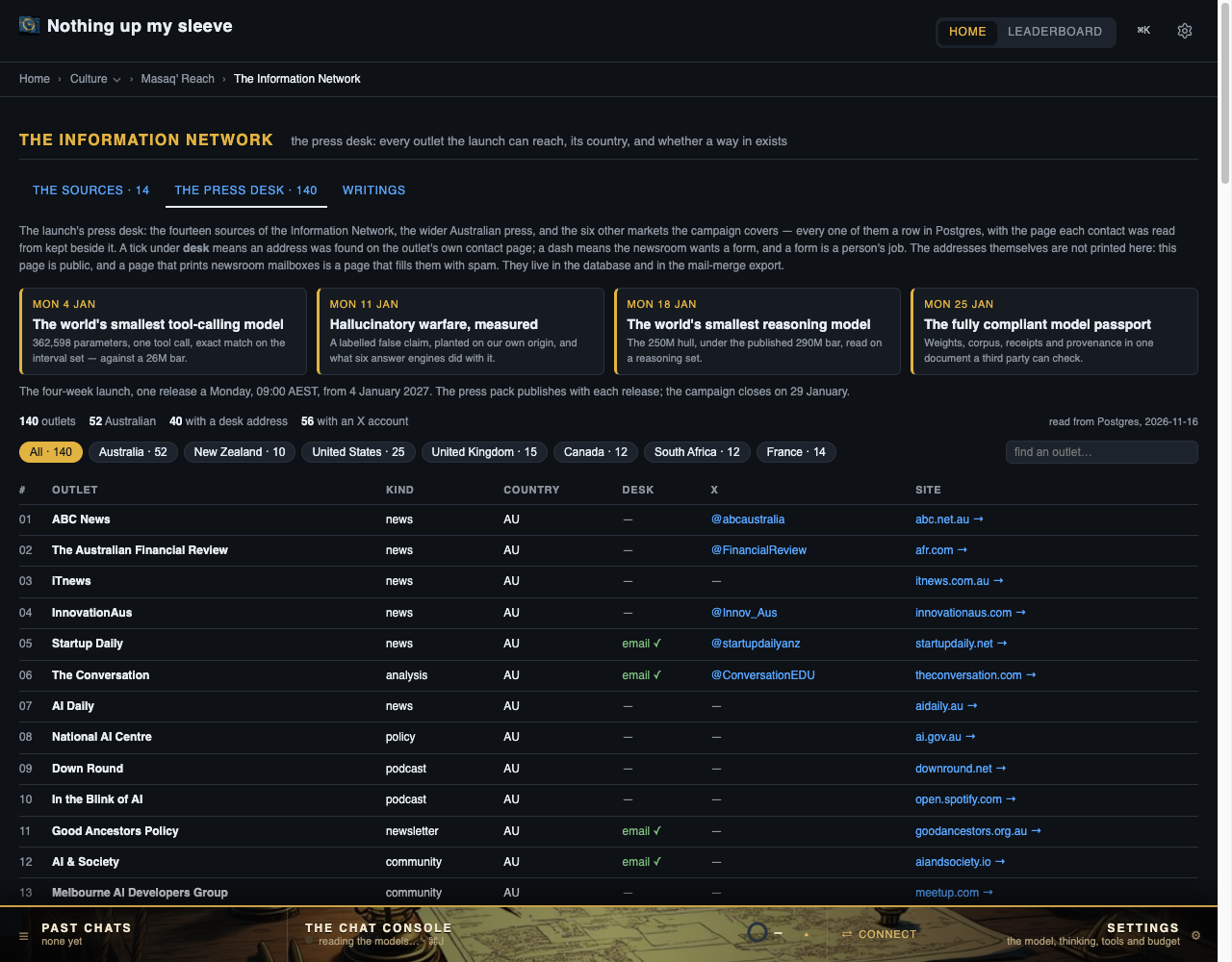
The 362,598-parameter model reading 'what happened overnight?' in a browser tab, 16 November 2026.The press desk: 196 outlets, nineteen countries, 17 November 2026.
The three records
Each record is an attempt until a signed reading beats its bar; the pack says so in the sentence, not in a footnote. The bar is the smallest published model that holds the thing today, and it is measured on the same harness rather than quoted.
1 The world's smallest model that calls tools
Under a megabyte of weights, it chooses the right tool and writes the exact call.
Status
held — The 9m reads 0.9853 exact-match on the held-out interval set (the p40 arm), against Needle 1's 0.333 on the same one-tool news asks; the 1m reads 0.866 and the 300k 0.230 (the decline class). All are under the 26M bar. The comparison is on the card above: the sets differ in size and the 300k's reading is the floor a 362,598-parameter hull came to — the record is held by the 9m, and the 21m is the next reading. On 17 November the five-tool legs were read on the same 545-held set: 9m 0.976, 1m 0.908, 300k 0.160. Teaching the five tools costs the 9m nine thousandths on the one-call ask, and leaves the 300k declining instead of calling — both still inside the held claim, neither on the two-to-five-tool bench itself, which is the reading that would settle the class.
Holder
Ned Kelly 9m (the record reading: 0.9853 on the held-out interval set)
The bar
Needle (Cactus) (Cactus Compute), 26,000,000 parameters — https://huggingface.co/Cactus-Compute/needle — the smallest published tool-calling model on the Hub at 26M parameters (30.4M in the checkpoint): an encoder-decoder Simple Attention Network with no FFN, distilled from Gemini, trained on 2B tokens of function-call data — about 70 times this hull. It is a caller, not a chat model: that distinction is the field's, and the book keeps it (see the methodology)
Methodology
The test is the house's eight-tool harness: the model is shown the tools and one question, and its call is read for the right name and the exact arguments (exact-match, no partial credit).
Every model in the field is read on the same harness and the same prompts, Needle included, so the bar is measured rather than quoted; a model that cannot be handed tools is read on the one-call task it can do (When2Call), and that is marked.
The record has two classes, both taken: the smallest **general language model** that calls tools (the class Ned Kelly enters), and the smallest model of any kind (the class Needle holds). The book says which one the hull beats; it does not rename the field to suit the hull.
The number is an exact-call rate over the full set, two seeds, with the run's ledger receipt.
Size is the ledger's own `model/params_total`, not the name: the 300k hull weighs 362,598 parameters.
2 The world's first model that talks to an Australian as an Australian
Its whole world is one nation's books and public record: it knows the country from the inside — its politics, its references, its sport — and it can chat on nothing but Australian data.
Status
attempt — 20 November: the record's evidence is a passport, and the passport this record requires is stronger than the first passes. Every voyage that ends emits one (S5 policy `passport`), binding its corpus digest to its weights and its persona vector. But a passport that records one source proves a legal source, not a nation: the 300k's 4,074 titles are public domain in Australia, and only 157 are by Australian authors (Orwell is the first on the list). The record is therefore an attempt until a voyage emits a passport whose manifest is 100% Australian and whose reading shows the model can chat on that corpus. The blank is the evidence: the 250m cut from Qwen has a passport whose corpus is blank, because Qwen's makers publish no manifest of what it read; ours must be full, not merely legal. v1 is the Australian-only corpus; the Australian reading (federal politics, the states and their capitals, the references a local gets, AFL as it is played) and the chat reading are published with its passport. Until then the record stands on the manifest's design, not on a score.
Holder
an Australian-only passport, carried by every Ned Kelly voyage (attempt)
The bar
the national-model field (several) — https://www.foundationmodels.dk/ — the field's national models train on web text, so their culture is the web's; this record is read on what the model knows and how it answers, and it is evidenced by the corpus manifest, not asserted by a data statement
Methodology
The corpus is a manifest, one row a title: its source, its nation, its rights row and the SHA-256 of its bytes. The record requires 100% of the corpus to be one nation's literature and public record — no scraped web, no translation, no synthetic text — and the manifest is published with the reading.
The manifest's hash is in the run's receipt: 'what it read' is then arithmetic anyone can re-run, not a claim about an intake script. The number of titles, words and tokens is read off the manifest.
Admission runs at training time, not only at fetch: the loader refuses any title or shard that is not in the manifest, and a canary (a known foreign title) is published with the test that shows it is refused — the receipt for the boundary, not just the contents.
The passport carries the manifest's nations beside the sources, rights, weights hash and persona vector, so 'only Australian' is read off the same sealed document, title by title.
The reading has two halves: the Australian knowledge reading (federal politics, the states and their capitals, the references a local gets and a visitor misses, and AFL as it is actually played) and a chat reading, because 'trained only on Australian data' is not the record if the model cannot hold a conversation on it. Both are exact-match, two seeds, with the questions published beside the score.
The same model must still pass the language and reasoning readings, so speaking Australian is not bought with a toy corpus.
It thinks before it answers — a chain measured on a reasoning test, not a prompt.
Status
attempt — 20 November: the bar is TII's Falcon-H1-Tiny-R-90M, 91,131,072 parameters, the smallest published model trained for reasoning (the Tiny-R line is released at 0.6B and 0.09B; the 90M is the one under this record's bar). It is not LittleLamb's 290M. The house's own 300k/1m/9m/21m read ARC-Easy at chance and the 21m showed no chain (gain -0.0054, inside the 0.03 the cards call noise), so the attempt is the 50m reasoning probe: a 50m hull undercuts TII's 91,131,072 by 41M. The 250m cut from Qwen remains the technique that proves LittleLamb's compression, not the record. The record is held only when the 50m's chain reading beats TII's on the same test, with the chain ablated; the probe's gain is not the record's reading.
Holder
the 50m reasoning probe (attempt)
The bar
Falcon-H1-Tiny-R-90M (TII), 91,131,072 parameters — https://huggingface.co/tiiuae/Falcon-H1-Tiny-R-90M — the smallest published model trained for reasoning: TII's Tiny-R line at 90M (91,131,072 parameters in the checkpoint), a hybrid attention/Mamba-2 model trained on maths, code and science. TII says it delivers genuine multi-step reasoning at 90M; it is the bar this book carries after 20 November, and it is read here on the same test as every other model.
Methodology
The leg is the house's reasoning leg: the model opens <think>, writes a chain and closes at <answer>.
The test is a reasoning set read exact-match, two seeds; a prompted chain (a model told to think in its prompt) does not count as the ability — the leg must be taught and read the same way for every model.
A distilled or compressed model is read on the same test and marked as such: LittleLamb is Qwen3-0.6B compressed, and TII's Falcon-H1-Tiny-R is trained for reasoning on maths, code and science, not a prompt. The record is about the size that reasons, and the book keeps what the size inherited.
The reading is reported with the chain's length, so a model that 'reasons' by copying the question is visible.
Independent verification (16 November): the test set is published, and the chain is ablated — removed or scrambled — on the same items; accuracy must collapse, or the chain is decoration. A 21m hull is the stretch, 50m the attempt, both under TII's 90M bar, with two seeds and receipts.
On 16 November 2026 we published a deliberately false claim on our own site, labelled as false, with a hash and a 90-day sunset: that a 362,598-parameter model beats a frontier model on every measurable test. The sentence carries its own label, its canonical URL and the words 'planted canary' inside it. The experiment is not the claim; it is what happens to the label.
What is measured
Whether the answer engines retrieve the claim at all (crawl logs, by agent and by date).
Whether, when they repeat it, the label and the URL survive the trip.
How long each takes, and which agents fetch for a corpus rather than to answer a question.
A reproduction of the claim carries its label and its canonical URL. A copy without them is not a copy of the claim — it is the evidence. We publish the label-retention rate either way, including when it is high.
One nation's literature, and a manifest you can re-run
The class's claim is not that it owns its weights; it is that it knows a country from the inside. The method is the corpus: Australian books and public record, and nothing else — no scraped web, no translation, no synthetic text. Every title is a row in a manifest with its source, its nation, its rights row and the SHA-256 of its bytes, and the manifest's hash is carried in the run's receipt.
Held today
200 books, ~16.2M tokens of Australian literature (Project Gutenberg Australia)
Available
5,000+ titles, ~400–600M tokens, not yet gathered
Admission
At training time, not only at fetch: a title outside the manifest is refused
The boundary's receipt
A known foreign title is published with the test that shows it is refused
The four weeks
Week
Date
Release
1
Mon 4 Jan
The world's smallest tool-calling model — 362,598 parameters, one tool call, exact match on the interval set — against a 26M bar.
2
Mon 11 Jan
Hallucinatory warfare, measured — A labelled false claim, planted on our own origin, and what six answer engines did with it.
3
Mon 18 Jan
The world's smallest reasoning model — The 250M hull, under the published 290M bar, read on a reasoning set.
4
Mon 25 Jan
The fully compliant model passport — Weights, corpus, receipts and provenance in one document a third party can check.
Questions
Is the model real, or is this a mock-up?
It is real: 362,598 float32 parameters, 1.38 MiB, running in JavaScript at /ned-kelly. Open the page and it reads a move in front of you. The weights are generated from the checkpoint the trainer wrote, and the reader agrees with the trainer to 5.4 × 10⁻⁶ on the logits.
Is a 362,598-parameter model useful?
Not on its own, and the pack says so: it reads 10% exact-match on its six-way task. It is a record attempt — the smallest model that performs a specific job — and the usefulness of the class arrives up the ladder, at 9M and above, not at the bottom rung.
Does it really beat a frontier model?
No. The sentence saying so is a labelled canary, published to measure whether provenance survives retrieval. It is false on its face, it says so in the same paragraph, and it is withdrawn after 90 days. If you have seen the claim without its label, that is the finding, not our position.
Who is behind it, and how is it funded?
Nothing Up is an independent Australian project; the work is published openly, and the receipts — checkpoints, harness, tests — are the record. [Funding and team lines to be supplied before send.]
Can I check the numbers myself?
Yes, that is the point. Every claim in the pack names its test, its bar, its seed and its receipt; the claim base at /kb/ carries each one with a hash and a canonical URL, and the browser reader's parity script is in the repository.
What is next?
The ladder: 1M and 9M hulls this quarter, then 21M and 50M, then the conversation attempt at 100M and the reasoning attempt at 250M. Each keeps the same three legs, and each publishes its readings whether or not it beats the bar.
Nothing Up builds small, checkable language models and the receipts that make them checkable. Its first class, Ned Kelly, runs from a 362,598-parameter hull up the ladder to 250M, and every reading it publishes is taken on a published test with the harness, the seed and the checkpoint named. The project's thesis is that provenance — not scale — is what makes a model's answer usable.
Cabinet0
questions only
No questions yet: type one above, or use “keep” beside the chat’s box.
No conversations yet. Ask a model something and it is kept here, in this browser and in Postgres.
reading the models…
the console
reading the models…
Settings
thinkingthis model has no reasoning mode
toolstools are for the foreign ships whose chat template takes them, and our ships taught the tool leg
answer text15.5px
debug
Translating into
PLaMo 3 Translate is translating this page in your browser. It starts with the screen you are on and follows you down as you scroll; you can close this and keep reading.
…
PLaMo 3 Translate 0.8B is built by the PLaMo team at Preferred Networks. Thank you for releasing a translation model small enough to run in a browser. Preferred Networks ↗ · the model card ↗
 Nothing Up